

Wrongside Up: How Inside Out 2 Masterfully Portrays Biblical Humanity
and how it shifted my perspective of the Gospel


‘Since God in his wisdom saw to it that the world would never know him through human wisdom, he has used our foolish preaching to save those who believe.’
1 Corinthians 1:21 NLT
Disclaimer: Please watch the film prior to reading this if you so intend. Spoilers are littered throughout this piece.
Inside Out 2 rocked my world.
I don’t use that terminology lightly. I have found that as my understanding of storytelling as an art form deepens, my pallet for cinematic excellence grows more and more selective. Though films from my childhood are finite and unchanging, I find that their narratives develop in complexity upon every rewatch. It is only with age that I have come to realize that Marlin’s desperate quest for Nemo was trauma-driven. Or that perhaps Andy’s departure for college was, in actuality, more about Woody’s struggle with letting go. Or that- in some paradoxical way- the real monsters are the perceptions with which we limit ourselves, not Sully and Mike.
This past semester I took a course entitled Faith and the Art of Storytelling. In it, we explored five core elements of storytelling from a biblical perspective. They include:
The Beauty of Creation
The Destruction of Sin
The Need for Sacrifice
The Thrill of Forgiveness & Redemption
The Hope of New Creation
This foundational understanding of how a fictional narrative can mirror the experience of a follower of Jesus has radically altered the way I approach a story. My professor, a wise man named Father Aughtry, insisted that every good story includes these elements in their narrative. These concepts are interwoven into the fabric of the story. I didn’t quite understand him until I saw Inside Out 2.
The film opens with a beautifully animated sequence of updates about Riley’s life since the end of the first film. We see Riley thriving in her hockey career, singing boy band songs with her best friends, sharing quality time with her parents, and living the fun-filled life every thirteen year old girl dreams of. All is well.
What I found so interesting about this opening is how it centralizes Riley as the main character though she has considerably less dialogue than the emotions in her mind. The central conflict of the first film was between Joy and Sadness within Riley’s mind, and yet Pixar takes the time right at the beginning to address that Riley is happy and well despite these events. We don’t catch up with Joy and Sadness until after this has been addressed. What this does is directly tie an internal conflict with external wellness. Even though we saw Riley struggle in the first film because of Joy and Sadness butting heads, Pixar makes it a point to articulate that when Riley’s emotions are in touch with one another and the way they affect her, she is able to experience holistic wellness. The two work in tandem.
“A peaceful heart leads to a healthy body; jealousy is like cancer in the bones.”
Proverbs 14:30
All of these positive experiences in Riley’s life culminate in the creation of what is introduced as her sense of self (a structure that rest upon a pedestal in the center of her mind’s control room). We hear each memory and experience come together to say “I am a good person” in Riley’s voice.
My best friend (a speech pathology major and one far more scientifically inclined than I) coaxed me into taking an introductory neuroscience course with her this coming fall. If you know me well, you are well aware that I have always pledged my academic allegiance to the arts and humanities. In other words- science is not my jam.
With that being said, however, I have begun to see this provincial outlook of mine begin to widen the more I explore the connection between neuroscience and spirituality. I recently finished reading Curt Thompson’s Anatomy of the Soul: Surprising Connections Between Neuroscience and Spiritual Practices that Can Transform Your Life and Relationships. I highly recommend it to the scientific skeptic and enthusiast alike. Thompson describes the nature of emotion like this:
“Remember that emotion is not a debatable phenomenon. It is an authentic reflection of our subjective experience, one that is best served by attending to it.”
Curt Thompson, Anatomy of the Soul: Surprising Connections Between Neuroscience and Spiritual Practices that Can Transform Your Life and Relationships
In the film, Joy and Riley’s other emotions take it upon themselves to send her negative and/or painful memories and experiences on a one-way trip to the back of her conscience. This suppression is all fine and dandy until new emotions Anxiety, Envy, Ennui, and Embarrassment (as well as Nostalgia, albeit a bit early) enter the picture. The narrative is flipped on its head as Anxiety (quite literally) bottles the original emotions up and sends them away. With her hinderances aside, Anxiety gets to work on the total reconstruction of Riley’s sense of self.
What is so intriguing about this angle is that Anxiety never actually actively attempts to alter existing memories, but rather influences the way they affect Riley as she creates new ones. I found this especially interesting as I read about the concept of memory and cognition. Thompson writes that “even though you cannot change the events of your story, you can change the way you experience your story.” This is a two-way street.
Thompson’s analogy for this concept features a groom aboard the plane to his honeymoon. As the man fastens his seatbelt in preparation for takeoff, he replays the joyful events of his wedding day in his mind. These memories of his special day, however, will now be influenced by the anxiety he feels about the plane taking off. The environment in which we call memories to the forefront will alter the way we experience them. This is all based upon “the suggestion from neuroscience that as far as the brain is concerned, there is in fact no such thing as the past or the future.”
You may need to ponder this anecdote for a moment (as I did) before you are able to fully grasp its rhetoric. When I was finally able to wrap my mind around it, I was, in honesty, a bit freaked out. Suddenly I have the ability to ruin happy memories with present anxieties. How am I supposed to retain any sort of joy now? That’s where the opposite effect comes in.
“While you may have viewed the events of your life story as if they were irrevocably chiseled in granite, you have more power than you thought. You can begin to respond to this ‘objective reality’ quite differently if you embrace the deeper reality that in some respects your past as you have viewed it doesn’t even exist.” Curt Thompson, Anatomy of the Soul: Surprising Connections Between Neuroscience and Spiritual Practices that Can Transform Your Life and Relationships
Inside Out 2 is an incredible case study of memory and the construction of our autobiographical narratives.
Now, you may be wondering “okay, Brynn, you just successfully lured me into reading a bunch of funky neuroscience stuff. Where’s the Jesus part?” Thank you for your patience, my dear reader. Stay with me just a moment.
Remember those five elements of Biblical storytelling I mentioned earlier? Here’s how they take shape in Inside Out 2:
The Beauty of Creation // Riley is off to hockey camp with her best friends. The emotions are all working together in harmony. All is well.
The Destruction of Sin // Anxiety robs all other emotions of their validity and Riley abandons her friendships in her search for new validity and identity.
The Need for Sacrifice // Joy comes to the understanding that perhaps maturity comes with new emotions. In her time of hopelessness she admits that “I don't know how to stop Anxiety. Maybe we can't. Maybe this is what happens when you grow up. You feel less joy.”
Anxiety surrenders control of Riley’s emotions and sense of self as Joy exhorts her saying “Anxiety, you have to let her go.”
Riley suffers an intense panic attack that leads her to admit her mistakes to her best friends and understand her shortcomings.
The Thrill of Forgiveness & Redemption // Riley is forgiven by her friends, Joy and the other emotions are restored in their validity, and Anxiety is given a second chance- this time with new coping mechanisms.
The Hope of New Creation // Riley’s sense of self becomes the culmination of her previously suppressed memories and experiences in conjunction with those more desirable to create a loop of affirmations spoken over herself.
I would like to take a moment to touch on Anxiety’s surrender. This is the moment I have found myself discussing with many others who saw the film recently. The devastating profoundness of Joy telling Anxiety to let Riley go is something that seems to stick with people. I think it’s because it not only illustrates how we can care for ourselves, but also how we can love others well.
Loving someone is not wishing the absence of negative emotion or experience, but wishing your own presence in tandem with their sufferings.
This, if nothing else, is what I hope you take away from this piece. That love is not only inside out but wrongside up.
Greater love has no one than this: to lay down one’s life for one’s friends. John 15:13
Below is a visualizer I created to illustrate this concept.
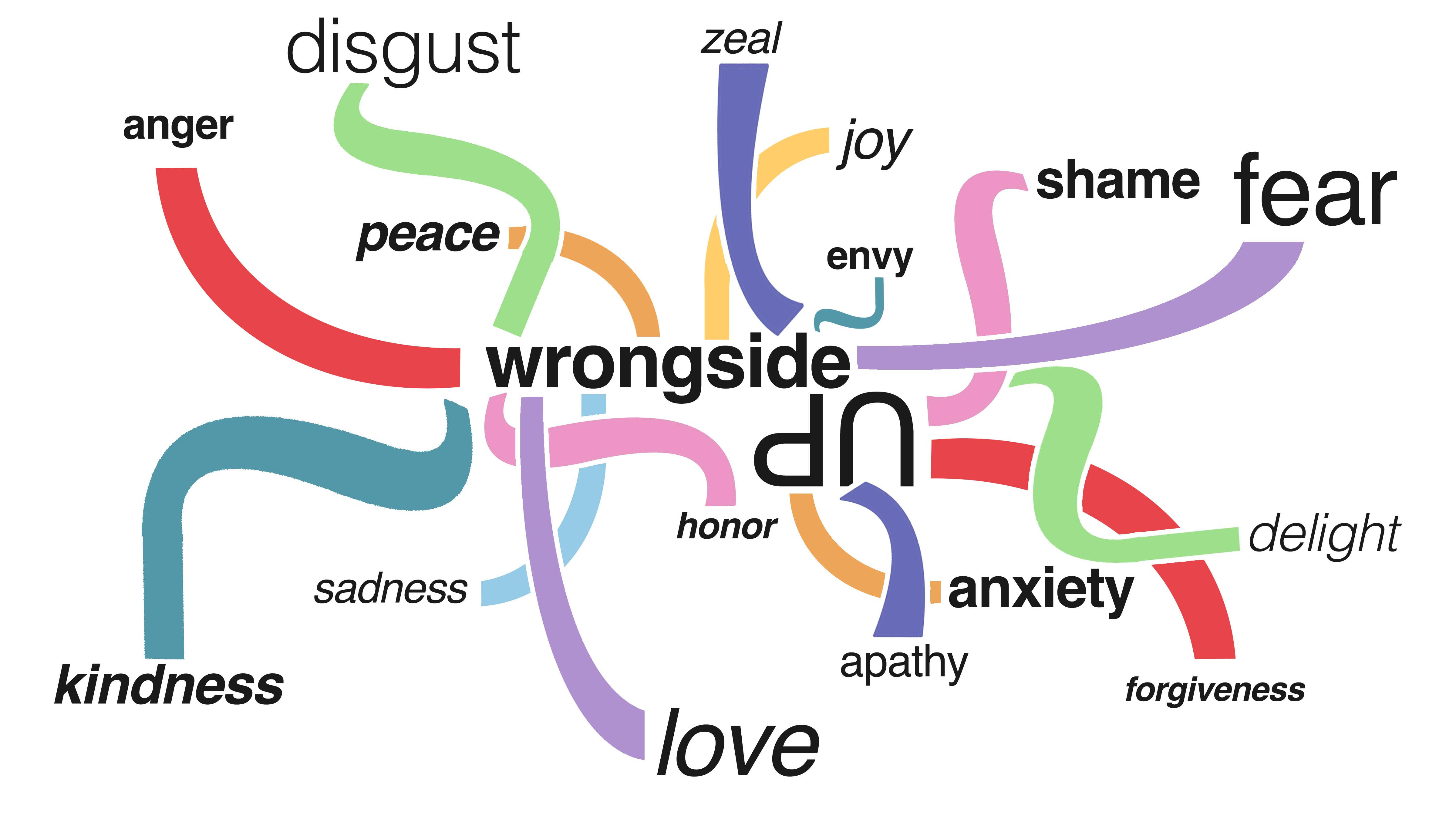
The way that we are called to love God’s creation- ourselves and others- is the way He has first loved us. The wrong way. The way that hurts sometimes. The way that rips at everything your flesh desires. This is the Gospel; that good news for our spirit is bad news for our flesh.
“In your life, God’s “way” is about loving him and loving your neighbor with all the parts of you. And this is hard work, especially for those parts of your “heart, soul, and mind” that have not had much practice doing that—the wounded parts, the weak parts, or the functions, such as memory or emotion, that you may not pay much attention to.”
Curt Thompson, Anatomy of the Soul: Surprising Connections between Neuroscience and Spiritual Practices That Can Transform Your Life and Relationships
For the love of beauty be kind to yourself and others.
As St. Augustine so wisely put it, “since love grows within you, so beauty grows. For love is the beauty of the soul.” The greatest investment we can make in others is to invest in our understanding of God’s creation and investment in us.
What is your sense of self saying to you? Are you listening? Good stewardship of our minds, bodies, and souls begs the knowledge that they do not belong to us.
The fourth element of storytelling, The Thrill of Forgiveness of Redemption, is what gives way to the hope of the new creation we long for. To forgive is to forgo the right for resentment. Many people will say that this means forgiving ‘your Judas.’ There is truth to this, yes, but if you are anything like me, it more accurately resembles allowing Judas forgiveness for himself.
Let it hurt a bit. Let the pavement dry before the flowers grow through its cracks. Don’t discard the 30 silver coins, but take them out of your pockets.
Living wrongside up is holding yourself accountable from the inside out. Do it gently.
Only by His grace,
Brynn
In loving dedication to Rebecca “Meme” Ross, In Ink & Deed’s most devoted reader and my mother, Angielique, a model of selfless love in my life and the inspiration for this piece.